
Prasad Rane
I have 10 years of experience building distributed backend systems in C#/.NET, Python and AWS. At Rocket Mortgage I led an OAuth2/JWT authentication migration and a legacy modernization, drove cross-team Kafka governance, and built an Amazon Bedrock assistant that routes requests to existing internal APIs.
verified In a 30-day June 2025 pilot, the Bedrock assistant handled about 70% of queries in three targeted domains for a beta group of underwriters.
About
I'm a software engineer with 10 years of experience building and modernizing C#/.NET applications across mortgage servicing, property management and field-device software. I combine hands-on debugging and delivery with user research, mentoring and operational improvements.
At Rocket Mortgage I led the rebuild of a legacy VB.NET underwriter application into .NET Core services, built self-service configuration tooling, and coordinated authentication and Kafka standards across multiple teams. Production AI experience includes an Amazon Bedrock intent-to-API assistant backed by existing internal services.
After the July 2025 Rocket Mortgage layoff, I took a career break until March 2026. Independent AI-tool building began in March 2026, and I started volunteering as a CodePath mentor in August 2026. The projects are below, and longer write-ups are on dev.to.
- RoleSenior Software Engineer: backend, platform, applied AI
- Core stackC#/.NET, Python, AWS, TypeScript, React, Angular, SQL
- LocationNorth Chicago, IL | Open to relocation and US remote opportunities
- StatusPursuing backend and platform roles
Experience
- Building independent AI tools since March 2026, including Code Turtle Engine (a compiler-grounded C# code reviewer) and Content Machine (an AI-assisted editorial workflow). Both are listed under Projects. Completed the AWS Certified Cloud Practitioner certification (April 2026) and AI coursework.
- Writing up the engineering behind these projects, and the Kafka governance work from Rocket, on dev.to.
- Career break following the July 2025 Rocket Mortgage layoff.

- Kept 300+ underwriters working through a six-month Active Directory retirement deadline, with no migration incidents observed at cutover, by leading the rebuild into .NET Core services behind a thin client with a phased cohort rollout
- Spared beta-group underwriters from opening legacy systems for about 70% of queries in three targeted domains in a 30-day June 2025 pilot, by owning orchestration and routing for a Python assistant on Amazon Bedrock
- Shortened business specialists' time to release supported loan product changes by an estimated 80%, by building the Angular UI and designing the configuration-driven Python FastAPI eligibility and calculations backend
- Reduced mortgage-assistance case delays for loss-mitigation specialists, typically avoiding an extra 24-hour wait for morning follow-up, by automating requeueing of failed requests after provider recovery using Dynatrace and SQS
- Made Kafka topic owners identifiable in incidents for five teams, all adopting shared standards for new services in three months, by convening a working group without formal authority to draft Kafka naming, access and schema standards
- Resolved two security audit findings, long-lived session cookies and credentials replayable across services, for APIs used by seven consumer teams, by moving the APIs to short-lived JWT access tokens validated in ASP.NET Core JwtBearer
- Cut support engineers' diagnosis of stuck loan modifications across four Lambda services from about 3.5-4 hours to 5-10 minutes in two compared incidents, by implementing request correlation across distributed systems linked by SQS
- Eliminated a legacy hotlist that left some loans waiting days for an assigned underwriter, moving underwriting onto shared casework across four services, by gating retirement behind Split.io flags held off a full business cycle
- Ended ten to fifteen second stalls, about three a week, in a loan-eligibility service running over 50,000 evaluations daily, with none seen in two weeks, by adding a timed
SemaphoreSlimgate around the contended vendor call - Removed the manual start-up of up to ten local services for engineers, who now bring up a prepared stack in under five minutes, by defining the services and health checks in Docker Compose so dependents wait for readiness.
- Brought a new intern stuck for two days in the loan-servicing code to a finished feature at sprint review about three to four weeks after a first walkthrough, by tracing one Angular component's data flow with the intern

- Eased SQL Server load at the Monday-morning peak of property managers' reports, lowering peak CPU from 80-85% to about 50-55% in one before and after comparison, by rewriting report queries with set-based joins and indexed temporary tables.
- Guarded tenants against duplicate rent charges on ambiguous provider timeouts, with no ledger corruption observed in covered sandbox tests and a monitored rollout, by building a .NET Core gateway with idempotency keys and reconciliation.
- Protected the mobile app and third-party integrations while speeding up support dashboards, with normal traffic and no error spike in Splunk after launch, by proposing and building a separate GraphQL route, leaving REST untouched
- Sped dashboard updates for hundreds of support reps and team leads, so nine in ten changes appeared within about 5 s at peak load, down from about 30 s, by replacing full-state polling with targeted ASP.NET Core SignalR delta updates

- Fixed a freeze on field optical test devices after offline sleep and resume, with no field reports of recurrence over about 90 days across hundreds of units, by tracing leftover polling work with QA using memory profiling and dumps.
- Replaced USB and email transfer of optical test reports with one-click in-app upload for field engineers, delivered on plan in three two-week sprints, by building an asynchronous HttpClient layer on API contracts set with the backend team.

- Launched a decoration firm's online catalog on go-live day with its Excel data already loaded and its owner walked through running it, by cleaning legacy spreadsheet data and loading it with SQL Server INSERT scripts.
Volunteer Experience
- Helped computer science students get unstuck on data structures and algorithms questions and career decisions as a CodePath volunteer (August 2026 – Present).
Projects
Independent projects built since March 2026. My professional work is under Experience.
-
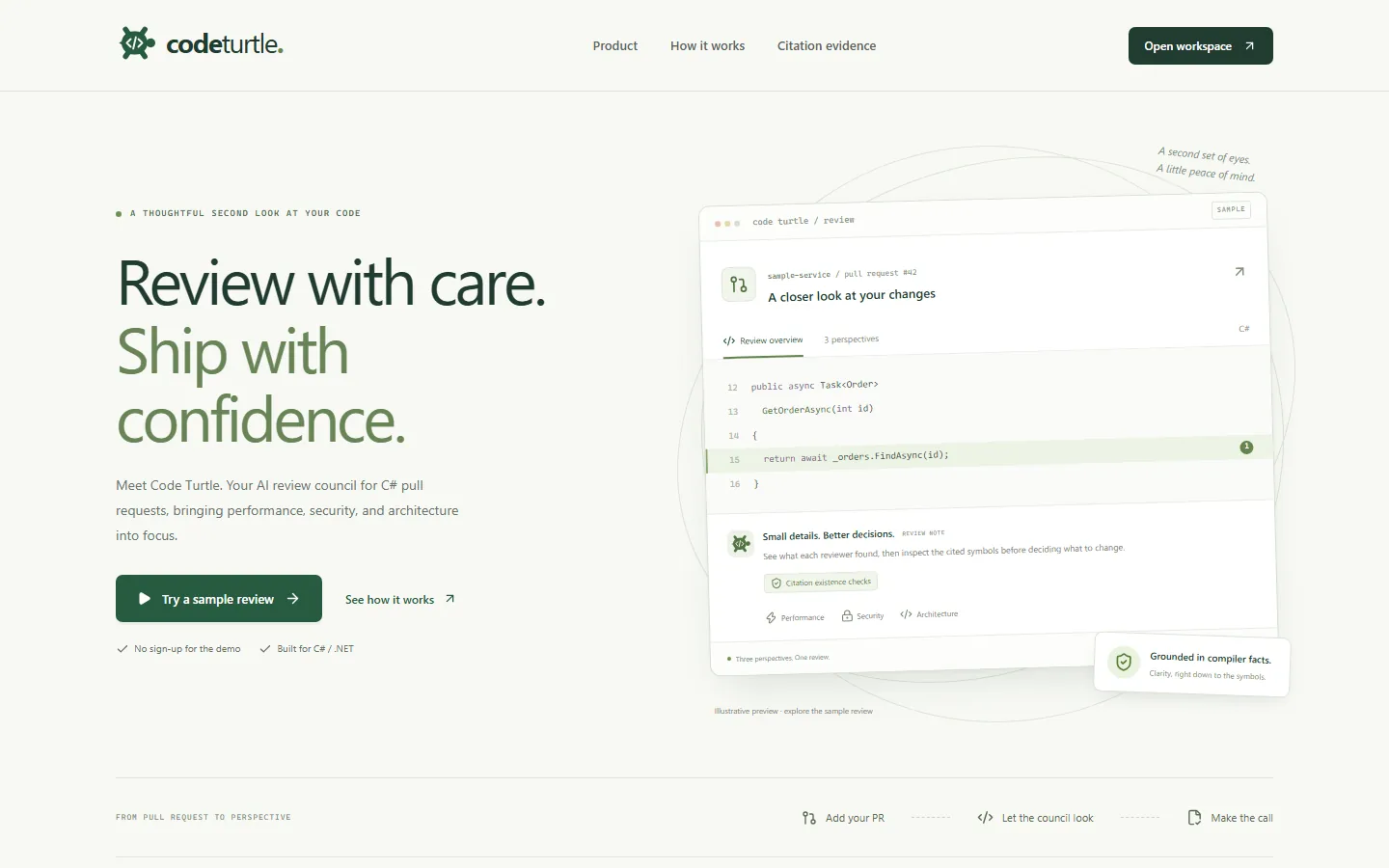
Landing page and sample review preview
-
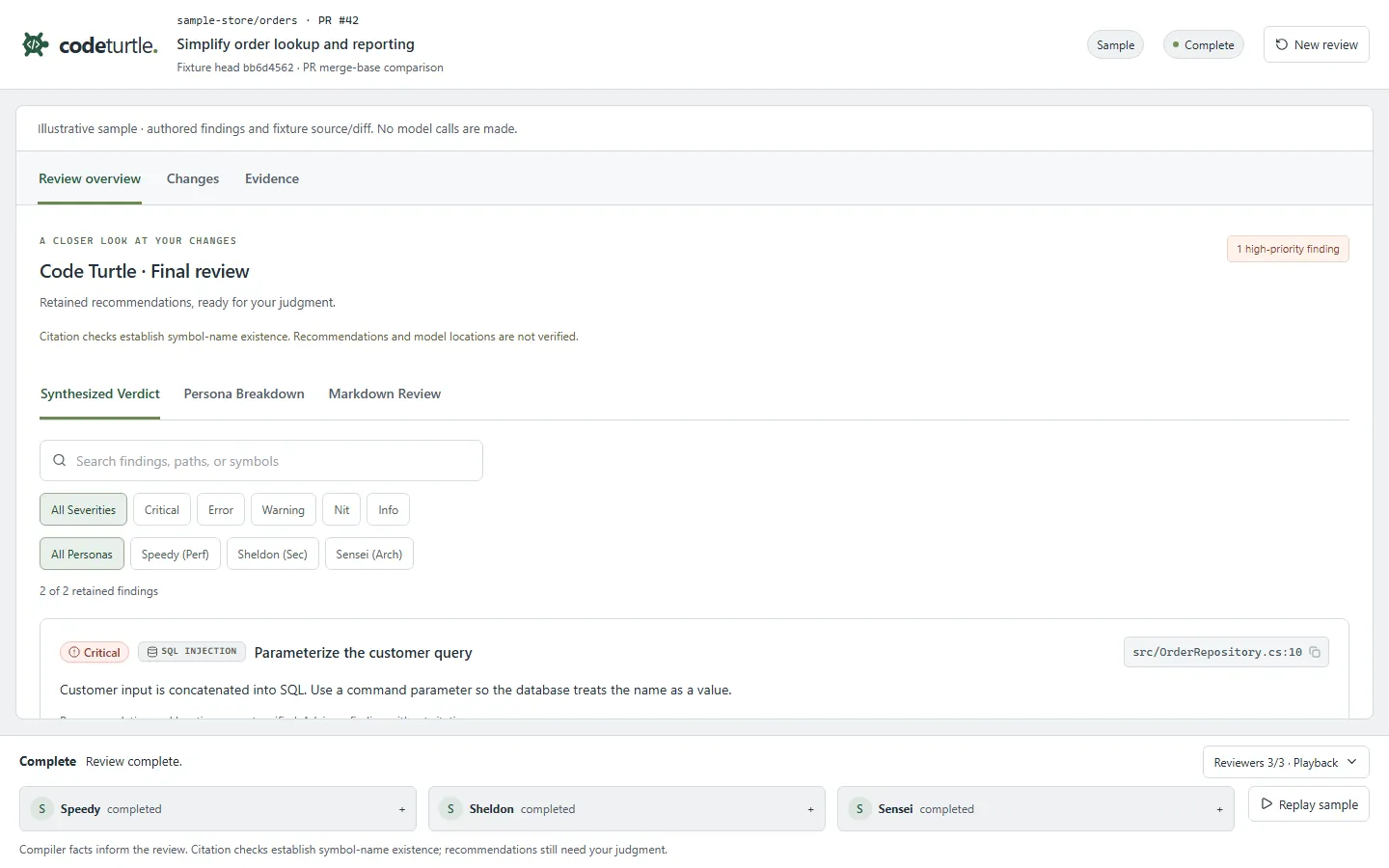
Review overview with severity and persona filters
-
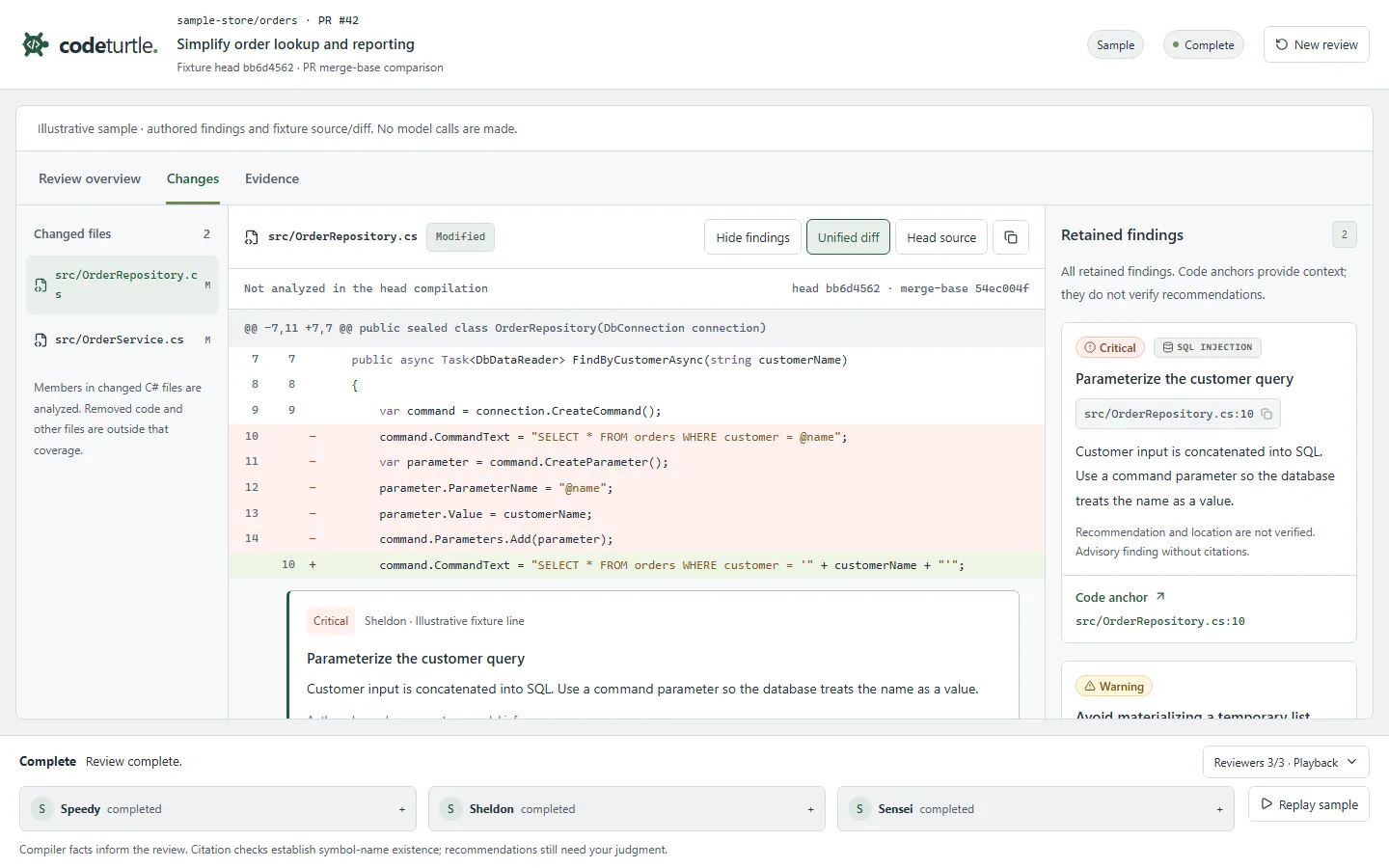
Changes tab: diff with inline findings
-
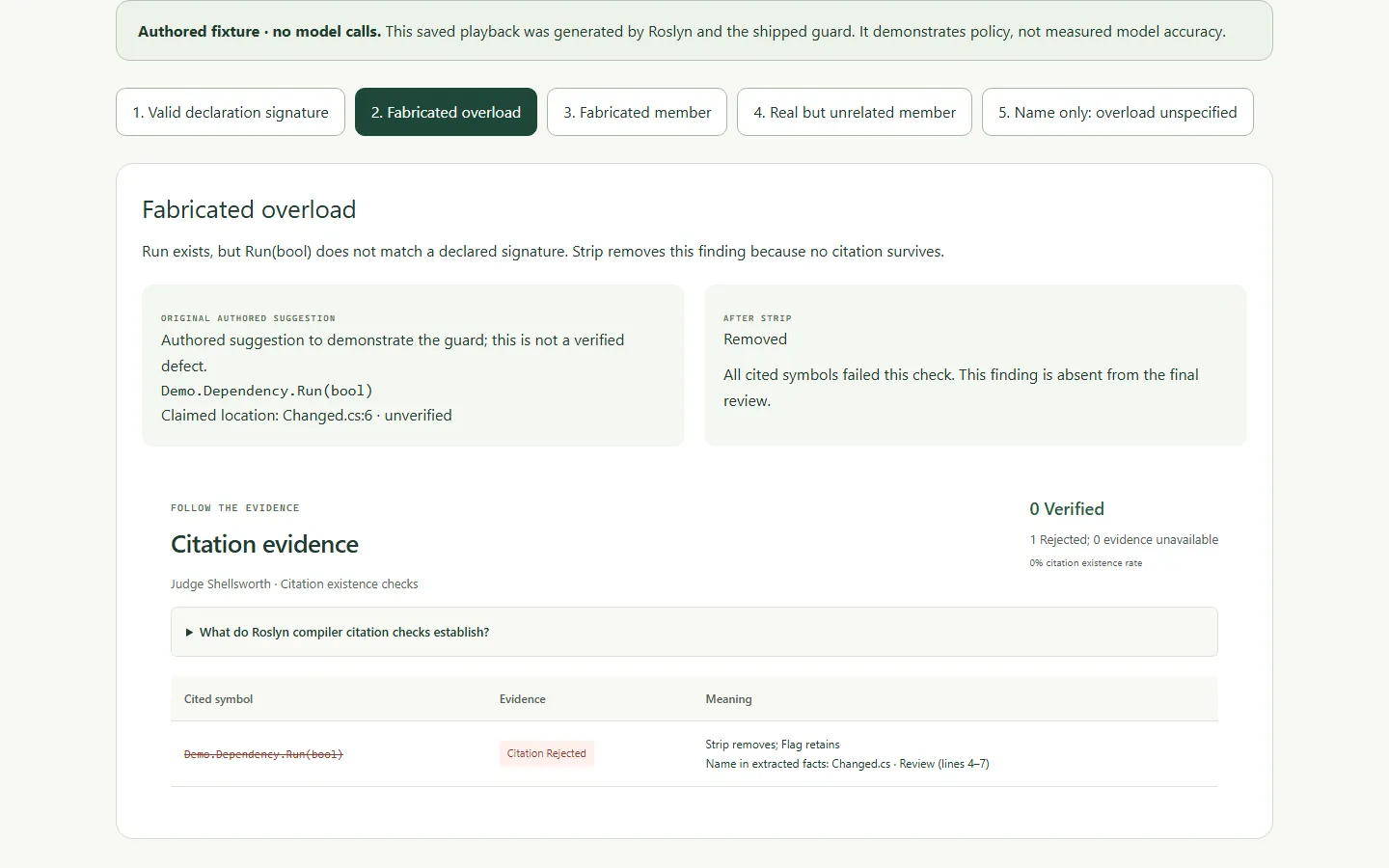
Citation guard rejecting a fabricated overload
Code Turtle Engine
A compiler-grounded C# code-review tool (.NET, Roslyn, web UI and CLI) built to address AI reviewers citing APIs that do not exist.
- Problem
- AI code reviewers cite types and members that do not exist in the codebase.
- Approach
- Roslyn extracts facts from members in changed C# files, and three LLM personas (performance, security, architecture) review them in parallel. A deterministic guard checks each cited type, member and supported signature against the compiler-fact payload and strips unresolved citations, leaving an auditable Payload/Compilation/Rejected trail.
- Scope
- Includes an offline, CI-verified citation demo with no model calls. Citation validation does not establish that every review finding is correct.
-
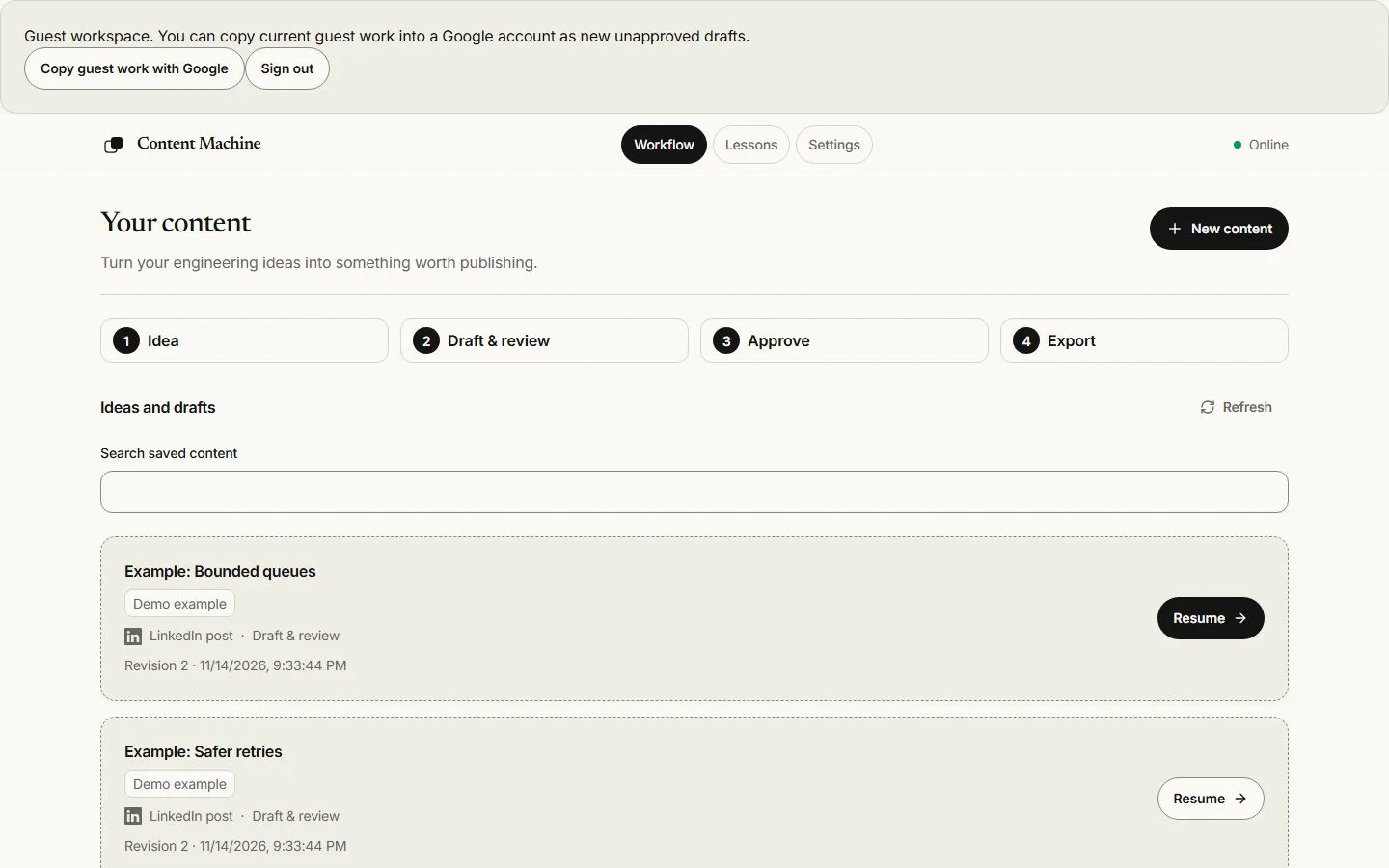
Your content: saved ideas and drafts
-
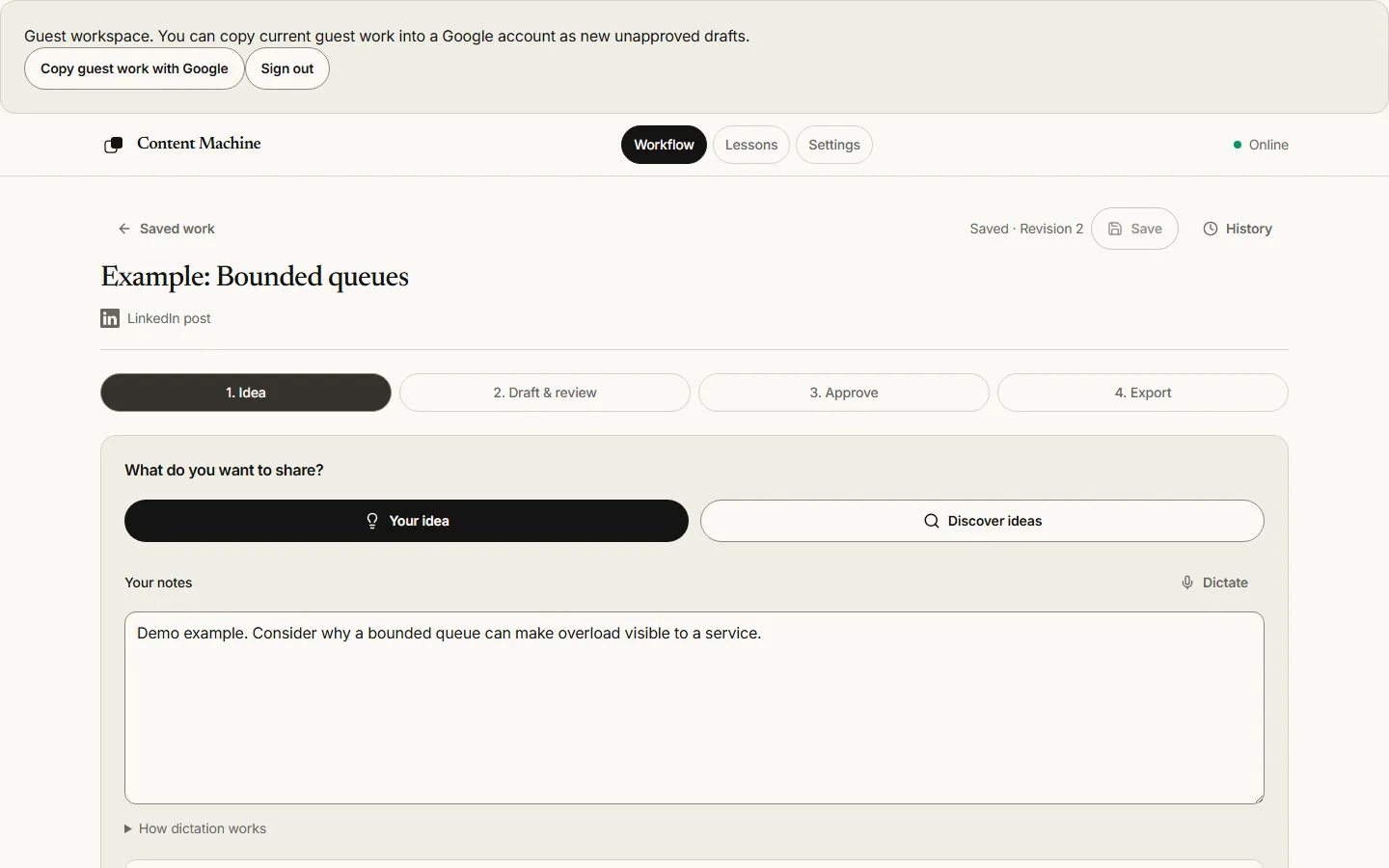
Step 1: capture the idea
-
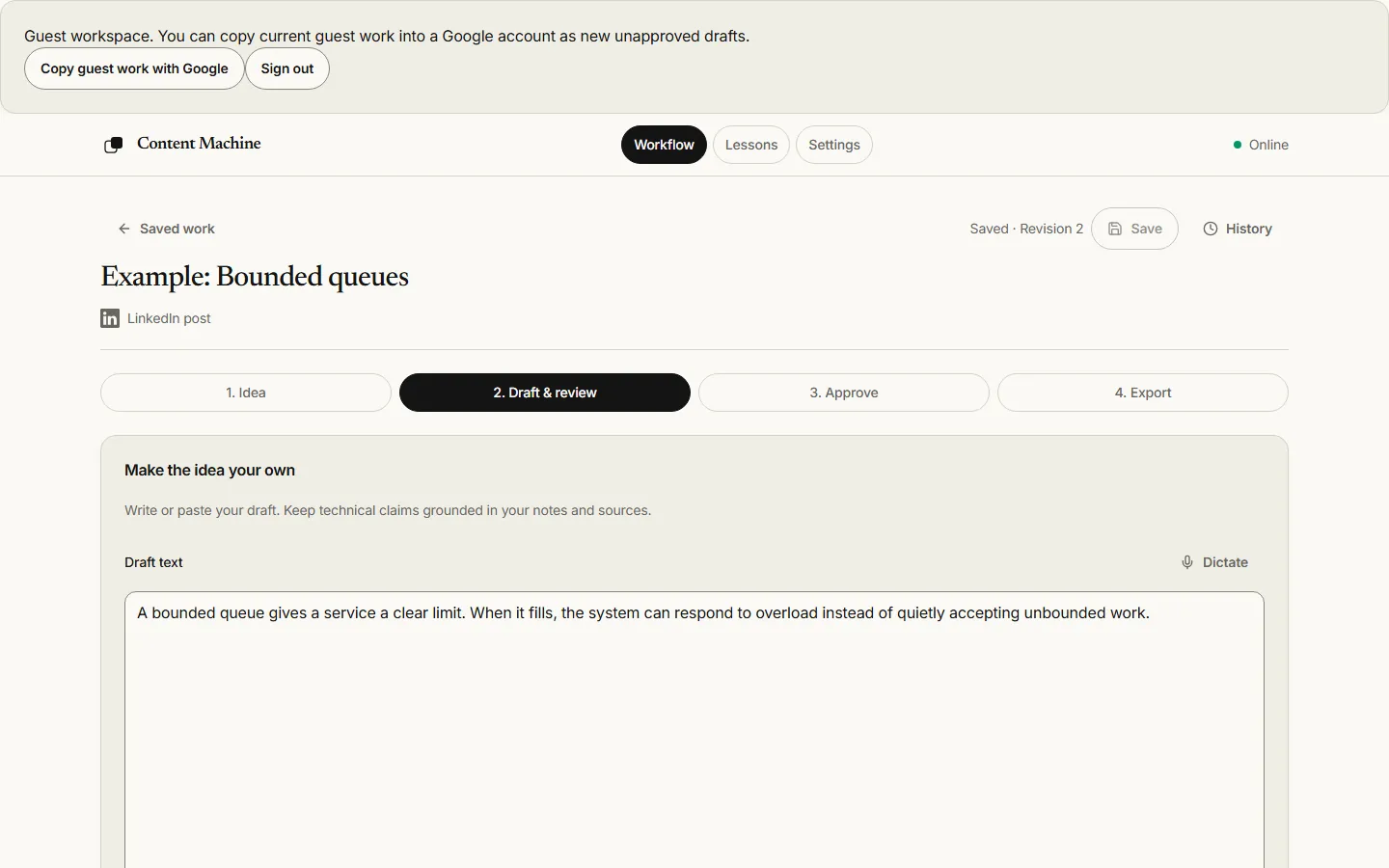
Step 2: draft and review
-
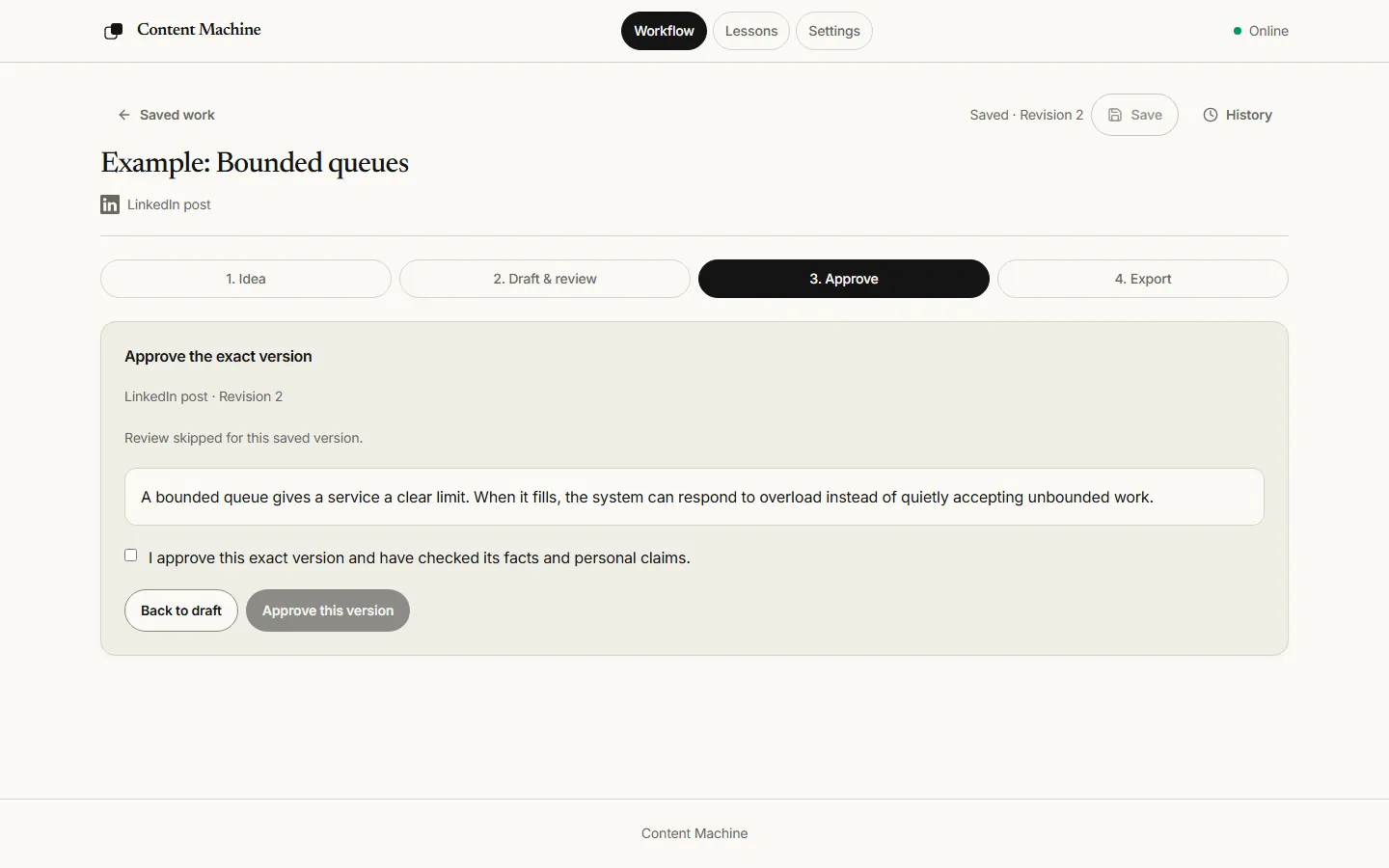
Step 3: approve the exact version
Content Machine
An AI-assisted editorial workflow with ingestion, rubric-based review, revision and human approval.
- Approach
- A Python workflow of ingestion, rubric-based review and revision, where every draft goes through rubric-based scoring, revision and human approval.
- Scope
- Judge scores support the workflow. They are not a verified guarantee of content quality.
Writing
- Starting Enterprise-wide Kafka GovernanceSetting standards across autonomous teams without authority.
- How I Use Coding Agents Without Losing My Mental ModelsWhere I hand work to agents and where I don't.
Skills
Education and certification



Get in touch
I'm pursuing backend and platform roles that connect my C#/.NET and AWS experience with practical AI integration. Email is the fastest way to reach me.
North Chicago, IL | Open to relocation and US remote opportunities